Peptide Delivery Methods Compared: SubQ, IM, Oral, Nasal, Topical
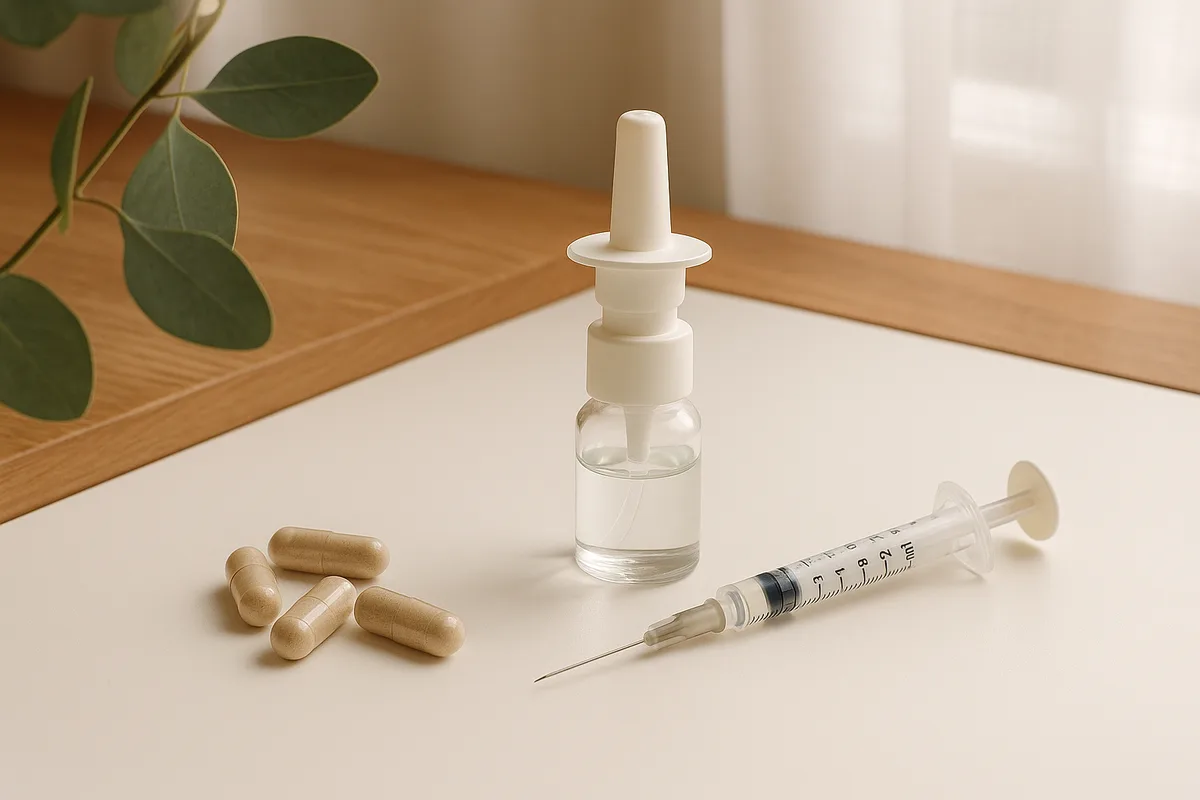
Bioavailability determines whether a peptide reaches its target tissue in sufficient concentration to produce biological effects. Route of administration shapes absorption kinetics, metabolic degradation, and ultimately experimental outcomes. Choose wrong and you're dosing a peptide that never reaches effective concentrations.
The fundamental problem with peptides is their fragility. These amino acid chains face enzymatic destruction throughout the body: proteases in the gut, peptidases in blood, cellular uptake and lysosomal degradation. Peptides evolved as signaling molecules with short half-lives, designed to act locally and degrade quickly. Using them as therapeutics or research tools requires navigating around biology's efficient clearing mechanisms.
Why Most Peptides Fail Orally
The digestive tract treats peptides as food. Gastric acid denatures protein structure. Pepsin in the stomach cleaves peptide bonds. Pancreatic proteases (trypsin, chymotrypsin, elastase) in the small intestine continue the breakdown. Brush border peptidases on intestinal cells fragment anything that survived.
A peptide taken orally typically shows <5% bioavailability, often <1%. Most of the dose becomes amino acids before absorption.
The intestinal barrier adds another obstacle. Peptides are hydrophilic molecules, often charged. The intestinal epithelium evolved to block such molecules, allowing passage only through specific transporters or paracellular routes under tight regulation. A random peptide sequence has minimal chance of crossing intact.
Oral delivery works for a handful of specially designed peptides. Semaglutide, sold as Rybelsus for diabetes management, achieves oral bioavailability through co-formulation with the absorption enhancer SNAC (sodium N-(8-[2-hydroxybenzoyl] amino) caprylate). SNAC transiently increases gastric pH and enhances absorption across the stomach wall. Even with this enhancer, oral semaglutide's bioavailability is roughly 1% compared to injected forms (Buckley et al., Journal of Pharmacology and Experimental Therapeutics, 2018).
The approval of oral semaglutide by the FDA in 2019 proved oral peptide delivery is possible with enough pharmaceutical engineering. It didn't prove it's practical for most research peptides. The formulation development required to achieve even 1% bioavailability cost hundreds of millions and years of clinical trials.
For laboratory research, oral administration of unmodified peptides typically fails unless you're specifically studying intestinal effects or testing absorption-enhancing formulations.
Subcutaneous: The Standard Route
Subcutaneous injection deposits peptides into the tissue layer between skin and muscle. Absorption occurs through capillaries permeating the subcutaneous space, with the peptide gradually entering systemic circulation.
This route offers several advantages. Administration is straightforward, requiring only insulin syringes and basic technique. The subcutaneous depot creates sustained release, with absorption continuing over 30 minutes to several hours depending on peptide properties. For research applications requiring steady plasma levels, this kinetic profile often suits experimental needs better than rapid intravenous bolus.
Bioavailability for subcutaneous peptides typically ranges from 70-90% compared to intravenous administration. The 10-30% loss comes from local proteolytic degradation and lymphatic uptake that bypasses systemic circulation.
Absorption rate depends on several factors:
Peptide size matters. Smaller peptides (<2 kDa) absorb faster than larger ones. Molecular weight above 20 kDa shifts absorption significantly toward lymphatic uptake rather than direct capillary entry.
Injection site affects kinetics. Abdominal subcutaneous tissue, with higher blood flow, absorbs faster than thigh or arm sites. Obese subjects show slower absorption due to reduced vascularity in adipose tissue.
Formulation alters absorption. Peptides in aqueous solution absorb faster than those in oily vehicles or sustained-release preparations.
For research design, subcutaneous injection provides reproducible dosing with moderate pharmacokinetic variability. The main limitation is injection volume. Subcutaneous sites tolerate roughly 1-2 mL in small animals, 2-5 mL in humans. Higher-concentration formulations are needed for large doses.
Intramuscular Kinetics
Intramuscular injection places peptides into muscle tissue, typically the vastus lateralis (thigh), gluteus (buttocks), or deltoid (shoulder) in humans. Animal models use hindlimb or flank muscle.
Blood flow through muscle exceeds subcutaneous tissue perfusion, producing faster absorption. Peak plasma concentrations after IM injection typically occur 15-30 minutes post-administration, compared to 30-90 minutes for subcutaneous dosing. Bioavailability is similar to subcutaneous routes, generally 70-90%.
The faster absorption creates higher peak concentrations and shorter duration of elevated plasma levels. For peptides with concentration-dependent effects or short half-lives, this profile might better match research objectives than subcutaneous administration's gradual release.
IM injection allows larger volumes than subcutaneous routes, up to 5 mL in humans. This matters for peptides with limited solubility that can't be formulated at high concentrations.
Muscle damage from injection is a consideration. Repeated IM injections at the same site cause inflammation and fibrosis, potentially altering absorption kinetics in chronic dosing studies. Rotating injection sites mitigates this but adds variability.
Comparing subcutaneous and intramuscular routes, the choice often comes down to desired pharmacokinetic profile rather than absolute bioavailability. Both work. SubQ gives slower, sustained absorption. IM delivers faster peaks. Match the route to the experimental question.
Nasal Delivery: CNS Access
The nasal route offers something injection doesn't: potential direct access to the central nervous system. Olfactory neurons extend from the nasal epithelium through the cribriform plate directly into the olfactory bulb. Peptides absorbed through the olfactory region can travel along neuronal pathways or perineural spaces into brain tissue, bypassing the blood-brain barrier.
This pathway is exploited by Semax and Selank, synthetic peptides developed in Russia for cognitive and anxiolytic effects. These peptides show poor oral bioavailability and limited blood-brain barrier penetration after systemic injection. Nasal administration delivers them to CNS targets more efficiently.
Research by Shadrina et al. (Journal of Drug Delivery Science and Technology, 2016) using radiolabeled Semax demonstrated that intranasal dosing produced brain concentrations 5-10 times higher than intravenous administration of equivalent doses. The olfactory pathway contributed substantially to this difference.
Not all peptides benefit equally from nasal delivery. Factors determining nasal bioavailability include:
Molecular weight: Peptides below 1 kDa cross nasal epithelium more readily than larger molecules. Above 10 kDa, absorption drops significantly.
Lipophilicity: Moderately lipophilic peptides penetrate better than highly hydrophilic sequences.
Mucociliary clearance: The nasal cavity clears substances within 15-30 minutes. Formulations must promote rapid absorption or mucoadhesion to prevent clearance before absorption occurs.
Enzymatic degradation: Aminopeptidases and other proteases exist in nasal mucosa. Peptides susceptible to N-terminal degradation may require modifications.
For research purposes, nasal delivery suits studies investigating CNS effects of peptides with poor blood-brain barrier penetration. Systemic bioavailability through nasal routes is generally lower than injection, typically 10-40%, but brain tissue exposure can exceed that achieved with higher systemic doses via other routes.
The technique requires specific equipment. Simple nasal drops often drain into the throat and are swallowed. Spray devices that disperse fine droplets coat the nasal mucosa more effectively. In animal models, special intranasal delivery devices prevent drainage into the throat during administration.
Topical Application: Local vs Systemic
Topical delivery applies peptides directly to skin or mucous membranes. The stratum corneum, skin's outer barrier layer, blocks most peptide penetration. Systemic absorption from topical application is typically negligible.
This makes topical delivery suitable primarily for local effects in skin tissue or for mucosal applications where the barrier is less formidable.
GHK-Cu appears frequently in topical formulations for skin research. This copper peptide is small (340 Da) and moderately lipophilic, giving it better skin penetration than most peptides. Studies by Leyden et al. (Cosmetic Dermatology, 2004) and Finkley et al. (Clinical, Cosmetic and Investigational Dermatology, 2012) showed improvements in skin thickness, collagen density, and wrinkle depth with topical GHK-Cu application.
Whether these effects come from peptide penetration to deeper skin layers or from surface action on keratinocytes remains debated. In vitro studies using Franz diffusion cells demonstrated that some GHK-Cu penetrates through excised skin, but concentrations in deeper layers are low (Abdulghani et al., Skin Pharmacology and Physiology, 2018).
Penetration enhancers, chemical compounds that temporarily disrupt the stratum corneum barrier, increase topical peptide delivery. Options include dimethyl sulfoxide (DMSO), ethanol, propylene glycol, and fatty acids. These work but can cause irritation and have their own biological effects, complicating interpretation in research settings.
BPC-157 cream formulations appear in research contexts, though published data on topical BPC-157 is limited. The peptide is larger (1419 Da) than optimal for skin penetration. Any effects likely derive from action on surface epithelium or shallow dermal layers rather than deep tissue penetration.
Mucosal delivery offers better absorption than skin. Sublingual (under tongue), buccal (cheek), rectal, and vaginal routes all have thinner epithelia and higher permeability than skin. Sublingual peptide formulations achieve systemic bioavailability of 10-30% for some sequences, though this varies enormously by peptide structure.
For research design, topical delivery makes sense when investigating local skin effects or when systemic absorption is deliberately avoided. Attempting systemic effects through topical application of unmodified peptides generally fails unless the peptide is exceptionally small and lipophilic or absorption enhancers are employed.
Intravenous: The Reference Standard
Intravenous administration serves as the 100% bioavailability reference against which other routes are compared. The entire dose enters circulation immediately, producing rapid peak concentrations and allowing precise pharmacokinetic characterization.
For research purposes, IV delivery suits studies requiring exact plasma concentrations, rapid onset, or elimination kinetics determination. The disadvantages include technical complexity, requirement for vascular access, and pharmacokinetic profiles that may not reflect physiological peptide signaling patterns.
Most endogenous peptides function through pulsatile or localized secretion rather than sustained systemic levels. Reproducing physiological effects might require dosing regimens that mimic natural patterns, which IV bolus injection doesn't necessarily provide.
Continuous IV infusion via implanted pumps offers sustained delivery but adds complexity and cost appropriate only for specific research questions.
Matching Route to Research Design
Choosing administration route requires aligning delivery characteristics with experimental objectives:
For studies investigating systemic effects where you need reproducible dosing and moderate duration of exposure, subcutaneous injection provides the practical standard. It's technically simple, well-tolerated in chronic dosing, and produces consistent pharmacokinetics.
For experiments requiring rapid onset or high peak concentrations, intramuscular or intravenous routes suit better.
For CNS research with peptides that don't cross the blood-brain barrier, nasal delivery offers access that injection can't provide.
For skin research or deliberately localized effects, topical application makes sense.
Oral delivery works only for specifically designed peptides or when testing absorption-enhancing formulations.
The literature on any given peptide often shows heterogeneous administration routes across studies, making cross-study comparison difficult. Bioactivity observed with one route might not appear with another, not because the peptide lacks activity but because delivery failed.
Researchers encountering null results should question whether the peptide reached target tissues at adequate concentrations before concluding it lacks biological effects. Similarly, positive results with one delivery method don't guarantee other routes will work.
Peptide research requires as much attention to pharmacokinetics as pharmacodynamics. The biological effect you're investigating might be real, but invisible if the delivery method doesn't achieve adequate exposure.
This content is provided for educational and informational purposes only. Matter products are sold strictly for laboratory and research use. This material has not been evaluated by the FDA and is not intended to diagnose, treat, cure, or prevent any disease.